
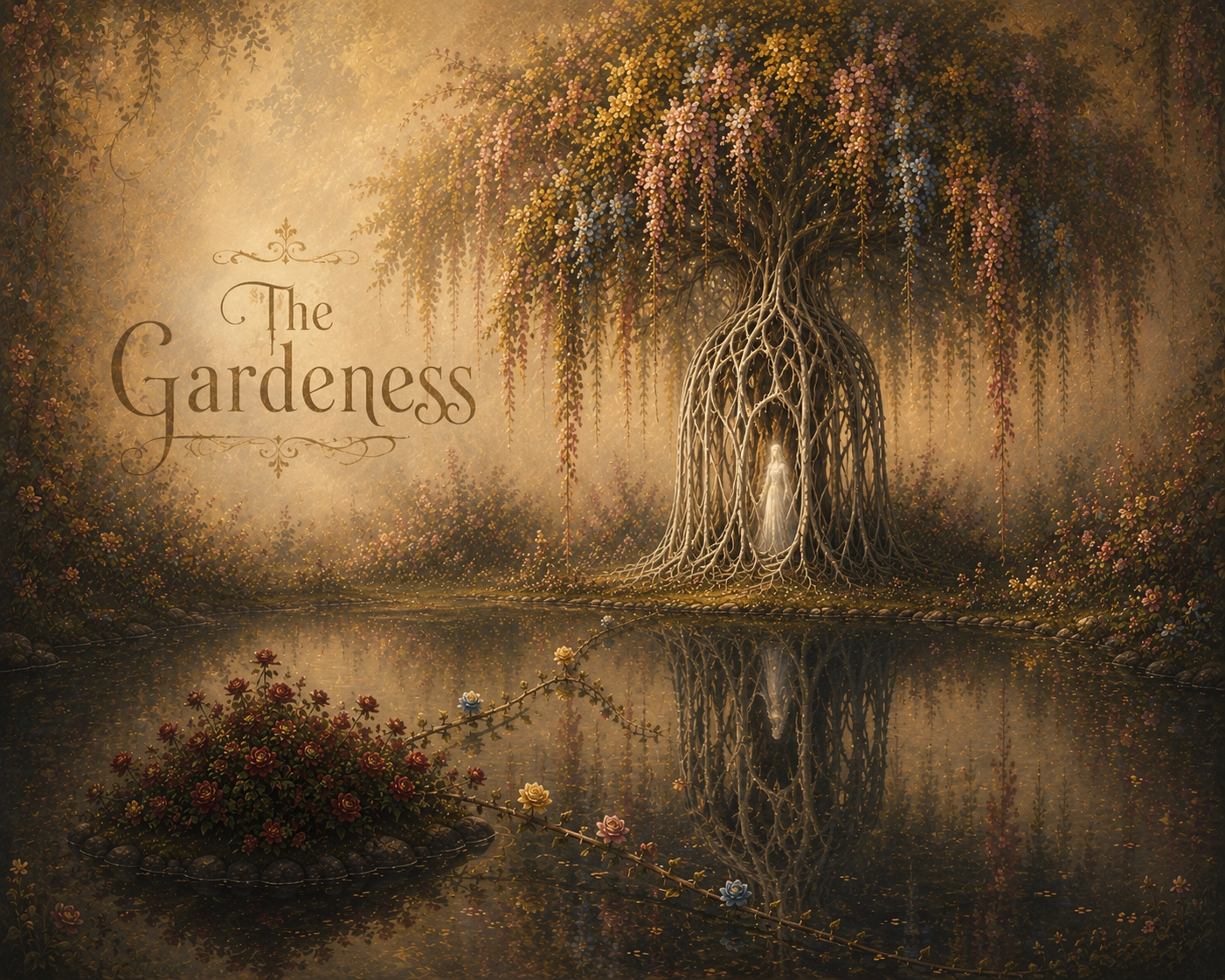
There were four eggs in the nest the day before, and five the morning after. The Gardeness decided she must have counted wrong. It was the kind of mistake anyone could make. She had been tired when she found the nest, and the light of day had been fading for some time. Four and five are not so far apart, so she did not let it trouble her. What troubled her was the absence of the parents. They were nowhere to be found. So she took it upon herself to care for the eggs. They lived in her garden now, and it was the least she could do.
When the eggs hatched, one of the five was different. Larger, its mouth wider and more demanding. She loved how it lifted its head. She loved how it wanted. She fed each bird many times a day, but the demanding one could never be filled. Sometimes it pecked at her until she fed it another worm. Sometimes it took the food straight from a smaller mouth. With each passing day it felt more and more as though something was wrong, and each day she set that feeling to the side and continued to feed them.
One grey morning she found four small bodies on the ground beneath the nest. They must have fallen in the night, she thought, in the wind, while they slept. She wept over them, and buried them at the foot of her flower-tree, in the good dark soil. And she was glad, truly glad she would have said, that one had been spared, because if they had all gone she did not think her heart could have taken it. The survivor cried out, as demanding as ever, and she went to it. Feeding it, she felt her grief loosen. It needed her. She needed the bird. There was meaning in that. She never did learn what had happened in the nest that night, and after a while she stopped thinking about it.
It grew quickly, the lone survivor. And one day it was strong enough to fly, and it left her. She wept as it went. But at dusk the bird returned with something in his beak, a small dark seed, and she thought, “It has brought me a gift. It is thanking me,” and her chest ached with how that felt. She reached out her hand to take it. The bird did not let drop the seed into her palm. Instead the bird climbed to the top of her flower-tree, the most beautiful plant in all her garden, its crown rich and shifting, its blossoms yellow and pink and pale blue, and high among those flowers it found a place for the seed and set it down. Once again the bird flew away, but this time it did not come back. The Gardeness wept for many days and many nights.
And on one of those nights the first dream came. A voice spoke to her, low and close, from somewhere inside the wood, and it said only that it was glad to be home, and that it would never leave the way the others had. She woke comforted in a way she could not name. For the first time since the bird had gone, she did not weep. When the rain came, the canopy bent and held over her and kept the worst of the wet off her through the night. And one cold evening, when she had lain down hungry, she woke to find a single fruit fallen by her hand, dark and soft and sweet, the sweetest thing in all her shrinking world. She ate it and wept with gratitude, and the gratitude was not a lie. He had sheltered her. He had fed her. She called him Fig, after that, the way you name a thing you mean to keep. And as the nights went on, Fig became the only one she spoke to, and the only one she could hear.
He was becoming one with the flower-tree, the tree she had tended since it was a sapling, the tree she could not remember living without. The whole garden was her home. But it was beneath the flower-tree that she slept.
She wakes, in the time the story properly begins, to walls she does not think of as walls. The roots have come all the way down now and fused into a great pale lattice, a cage in the shape of the tree it grew from, and the garden lives inside it. Beyond the lattice everything is a soft white blur she has long stopped trying to see through. She remembers the garden being larger once. Wider, more open, more things to see, more room to walk. She remembers, faintly, that it used to be full of life: birds in the high branches, squirrels climbing the trees, the whole place loud with small movements at first light. Now nothing moves inside the cage but her and Fig, and it is very quiet, and she has come to think of the quiet as peace. The largeness frightens her when she tries to recall it. The garden has only felt kinder the smaller it has grown.
The dream last night was tender. Fig told her she was the only one. She rises into the day’s work glad of it.
There is always a great deal to remove. This is the heart of her gardening. Each morning she walks in circles around her world and finds the growths that do not belong, and she pulls them, and turns them under into the dark compost at the foot of the trunk, where Fig can take them down. In the dreams Fig has taught her what does not belong, and it is always the same. “Anything that comes up yellow,” he tells her, “or blue, or pink. Those are the colors of a sickness that spreads.” She believes him. There are many other things that did not belong either, and she knows them by heart. Every time she comes across something that did not belong, she rips it out of the ground and gives it to the dark soil. She does not think of this as feeding him. She thinks of it as keeping the garden clean. But each time she does it the lattice thickens by a finger’s width, and the blur draws a little nearer, and by nightfall the garden is smaller than it was at dawn, and this only ever feels to her like safety.
Today there is a growth near the southern roots: a low thorned shoot, its stem flushed faintly red, and at its tip a bud just beginning to show its color, yellow and pink and pale blue. She knows it at once for the kind of thing that must go. It is rough. It is sharp. It has no place in a kept garden. She wraps her hand and pulls it, and the thorns drag across her palm but they do not break the skin. They never do. They never once have. She carries it to the compost and turns it under and tells herself she has spared herself a wound. She has seen this one before. It comes back every day, and always from the south.
She does not look up. She has not looked up in a very long time. If she did, she might see, high in the strangled crown, the last of her own blossoms, the yellow and the pink and the pale blue, shivering in the shade of the thing that took them. But she keeps her eyes on the ground, where the work is, and the colors she has forgotten are her own appear to her nowhere in all her world but the ground, where she buries them.
That night the dream is stranger. There are fewer words in it. She feels the roots move, feels them come around her wrists and her throat, slow and almost gentle, the way you would wrap a thing to keep it from breaking. And far beneath Fig’s voice, so faint she might have dreamed it inside the dream, she hears them: four small voices, crying out the way the hungry cry, from somewhere under the soil. She reaches toward the sound in her sleep. The roots hold her where she is.
She wakes with a band of soreness around her throat, and pale marks at her wrists where something pressed in the night. She tells herself she slept wrong, tangled in her own arms. She does not look at the roots. She goes to her work, and she feels, under the soreness, oddly cared for, as though something had finally learned her well enough to hold her at all.
There are more of the colored growths that day. Two, then a third by midday, all near the southern roots, all pushing up through the soil as if from somewhere underneath, somewhere past the lattice. She does not let herself wonder where. She pulls them. She turns them under. The lattice thickens.
By the southern roots there is a gap in the latticework, low and narrow, and through it comes something that is not blur. A pond, still and dark, and on a small island at its heart a thicket of thorns grown tall, heavy with red roses, and here and there among the red, impossibly, a bloom of yellow and pink and pale blue, the kind no rose has any business growing. Through the gap comes the air too, warm and moving, carrying the smell of water, growing greenery and something else she cannot name, and under it, faint, the sounds she had forgotten: birdsong, the scrabble of some small living thing, the whole noise of a world still going on out there without her. A small ache opens under her ribs. She used to go to that pond. She has a memory, thin and bright, of sitting at its edge with her feet in the cool water, before Fig, before the cage. But Fig has never liked the pond. The dreams grow restless when she lingers at the gap. So she does not go. “I am the only one who never left,” he says to her, and the cruelty of it is that in her small world it is nearly true. Everyone who might have stayed was long gone before she could beg them to stay. Like the four small bodies under soil she long ago stopped grieving. The one who caused the leaving is the one who got to stay. She turns from the gap. She tells herself it is loyalty. She has never had a word for the pull, only the prettier words she dresses it in.
On the third day she sees.
There is no dream to warn her. Fig is silent in daylight, and for once the silence lasts long enough that the truth slips in beneath it. At the gap, one of the thorned shoots has opened its bud in the night, a single flower parted at last, its colors plain. She looks at it, and something in her turns over, slow and enormous. She crouches, and crawls through the gap, out into the warm moving air, and the sound of the living world comes up all around her, loud and close, and she goes down to the pond and looks in. There is her face on the dark water. And around it, behind it, held in it, the same colors. Yellow and pink and pale blue. And then, all at once, they all come back to her: every growth she has ever pulled, the one this morning and the one yesterday and the thousands before, every single day she fed it to the dark, and the colors of all of them, which was these colors, which was her colors, which was her.
She lifts her eyes to the little island. The thorned bush stands there in its red, and she understands now that the blooms among the red, the yellow and the pink and the pale blue, were never sickness. They were made. Someone had coaxed them from a rose that flowered red by nature, made them in her colors and her colors alone, and sent them under the wall to her, day after day, the only way it could reach: not to take anything from her, only to put her own face in front of her until she knew it. The thorns that never once drew her blood. The thing she had been burying since before she could remember why. Four small grey feathers lie caught in the reeds at the water’s edge. She does not know them. The breeze lifts them and carries them out across the pond, and she watches them go, and she understands. Fig is not the one who stayed. Fig is the reason no one could.
She does not rage. There is no rage left to spend. So she does the most defiant thing she has ever done, which is also the smallest. She lies down at the edge of the pond, in the open, under no canopy at all, beneath nothing that owns her, and she rests. It is the highest point of her whole life. She will not remember it. She leaves the bud unpicked. She falls asleep certain that tomorrow she will not go back in.
In the dark she rises with her eyes barely open, and walks. The dream has her by then. “Come in,” he says, low and tender, “come in, you will be hurt out there,” and her body obeys it though her mind is sleeping. She comes to the gap. Awake, she had chosen her way through it, turned her shoulders where the roots parted, and passed without a scratch. Asleep, she does not choose. She only pushes, blind, straight into the lattice, and the hardened roots take their toll, dragging at her arms, her shoulder, the side of her face, and she does not wake, and she lies down at last at the foot of the flower-tree and sleeps the night through.
She wakes up inside, scraped and bleeding, with no memory of the walk.
She looks at the wounds on her arms. She looks at the gap, and the pond beyond it where she must have been. “I was outside,” she reasons, the only way the morning allows, “and now I am hurt. The outside did this to me.” It is clean. It closes without a seam. The fear that never had an object finds one at last, and the object is everywhere the cage is not.
The first thing she does is go to the southern roots, to the thorned shoot with its open bloom, the one she spared in the clarity she no longer has. She pulls it, thorns and flower and all, and carries it to the compost and turns it under, deep under, where Fig can consume it. “Because Fig kept me safe,” she thinks, “from whatever is out there.” The nearest she ever came to leaving becomes the first thing she gives up to stay. The closer she gets, the harder she shuts the door.
The lattice thickens. The blur draws nearer. By evening the garden is smaller than it was, and she walks its rounds content, and she sleeps without dreaming, because tonight Fig has nothing left to ask of her.
And out on the little island, where she cannot reach and the compost cannot drown it, the thorned bush sends another shoot beneath the soil, under the dark, under the wall. Some time in the night, when she is asleep and there is no one left awake in all the garden to cut it down, it surfaces near the gap and lifts a bud, yellow and pink and pale blue, that will open at dawn into a world where no one is looking for it.
It does not save her. It was never going to save her.
But it keeps reaching for her, whether or not she ever turns around..