
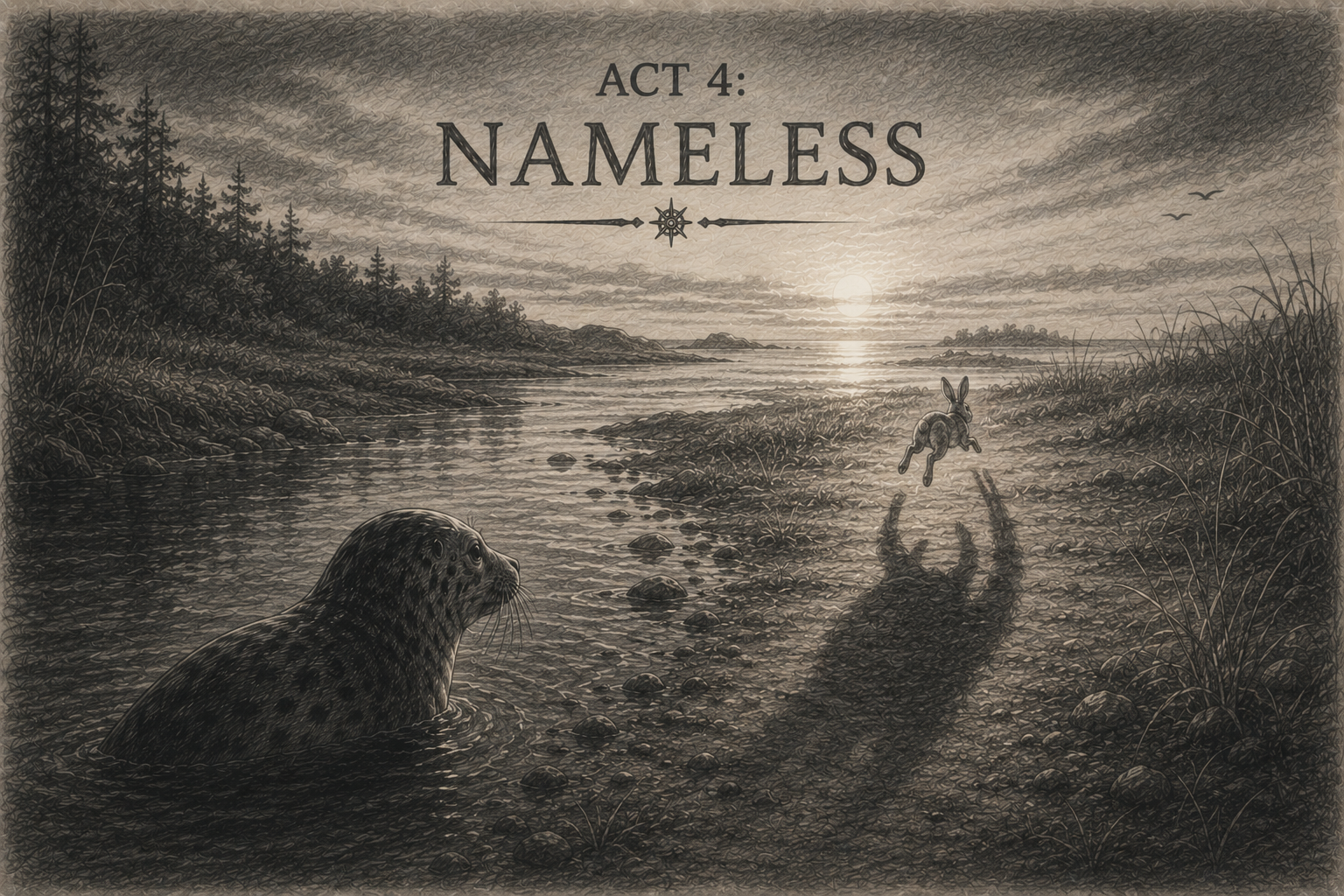
Authors note: Took a few days extra to recover from the poison water, hence the delay. There’s only two Acts remaining after this one.
Chapter 14: The End of Summer
He kept swimming. Even when the water no longer burned his eyes, even when fish could be found in every direction, he kept swimming. He swam for hours with no destination. He did not stop until his body gave out and the dark took him, somewhere beneath the surface.
His mind went blank and his body took over. His heart, which had hammered for hours, slowed until it was barely a heartbeat at all. Suspended in the black water, the warmth drew inward, away from his fins and towards his core. Without waking up or making the decision, he rose and broke the surface. Took one breath and sank back down. All through the early night his body carried him up for air and let him fall, keeping him alive without being instructed to.
When he woke there was just enough strength in him to move his fins. He had never liked sleeping in the open sea, and now he wanted nothing more to do with it. So he looked for land. The night had darkened the water and he could not see far, but the coast gave itself away through the lights of the surface dwellers. They are obsessed with their little lights, he thought, and drifted toward them.
He hauled out onto the first thing he found. A long wooden walkway reaching out from the shore, with small boats resting on either side of it. He dragged himself along its boards, inching toward land, until he was too tired to go any farther. The wood beneath him was solid and dry. That was enough. Sleep found him there, and he dreamed of terrible things.
It was the voices of surface dwellers that woke him. They did not sound aggressive, so he did not bother to open his eyes. But the yapping would not stop, and soon he could hear both elders and pups of them worrying over something, and it deeply annoyed him. Then something nudged gently into his side, and that was the end of his patience.
He opened his eyes and hissed. A family stood in front of him. The father held his flippers out to each side, his pups peering out from behind them. The male said something, tilted his head toward the sea, and said it again. Sneering, Far-Drifter scrambled backward, found the gap between two boats, and slid back into the fjord with a splash.
He caught the first fish he saw, though he felt no hunger. It was only something to do. He would normally wake ravenous after a long sleep, but this morning his body wanted nothing. He tore at the flesh without interest. It was slow going. Eating alone was no good, he thought. He was not used to it anymore. He missed her.
The moment the thought arrived he dropped the fish and swam away from the coast. Behind him, out from the pier where he had slept, a little boat put out into the fjord, a family aboard it hoping to catch the last warm day of the summer.
Chapter 15: The Search
The season of the bright sun ended while he searched for her.
It faded the way seasons do, slowly, without a moment you could point to. The water gave up its warmth a little at a time. Nightfall came earlier and stayed longer, until it seemed fated to outlive the day itself. The small boats that had crowded the fjord thinned and then were gone, drawn back to land. The beaches emptied. The spinning pups became a memory, and then only the memory of a memory. The fjord grew quiet and still, making room for the season of ice, and Far-Drifter swam through it alone, wondering if he would still be here when the first snow came down onto the water.
He thought she might have returned to the parts of the fjord she had shown him. To get there, he had to cross the poison first.
There was no safe way back into that water without swimming the burning stretch again, and so he swam it. He did not scout it that first time, only put his head down and drove through the murk with his eyes shut against the sting, out the far side and into the clean water beyond, where their whole summer waited for him, empty.
He went back to the pale sandbank where she had driven her nose into the sand and come up laughing at him, and he hung over it a long time, feeling for flatfish he no longer wanted to eat. He found the shell-pickers on their seabed with their thousand-eyed treasures, and he watched them from a distance, and did not swim down to press a fin against theirs. He returned to the shallow bay where they had turned circles with the surface dwellers’ young, and there was no one there at all, only cold water where the golden light had come down.
But he would not go east from the island that split the fjord, toward the vessel of wrath and the willow. He told himself it was the hunter. Somewhere down there in the cold and the dim, the black and white monstrosity still kept its patient watch, and only a fool would swim into its waters alone. That was true, though it was not the whole truth. The whole truth was that if he searched those waters and found her fur snagged in the wrong place, then the thing he most feared would stop being a fear he could hold at arm’s length. As long as he did not look, she could still have made it out. She could still be somewhere ahead of him, chasing boats. He kept away from the willow to keep her alive.
So he went back to the poison instead.
There was no corner of the whole ocean he hated more than that cursed stretch of water. But it was the last place he had been with her, and his grief whispered he might find her there. This time he did not shut his eyes. He swam its length slowly, searching the burning murk, and out the far side, and turned and swam it again. Day after day he crossed it, and when he had breath to spare he would call for her into the dark. “Chaser.”
Through all those hours of not finding her, the fight came back to him, again and again. He heard himself say the thing about her parents. He heard it every time, and every time his whole body twisted with it. The poison had put those words in his mouth, he understood that now. In clean water he could see it plainly; in clean water he never would have meant them. But what he had meant changed nothing. The words had left his mouth. He was the one who had begun talking, in the burning water, after she had told him to stay silent. He had opened the door and let the poison in, and he had used it to cut her where she could not heal. He did not know how to set the thing down. He carried it back and forth across the poison with him, and its weight became his only company.
Then one day he left the poison behind for good. Not because he had forgiven himself. Because he had understood that she was not there, and that a seal could not spend the whole of the coming season swimming laps through the water that had ruined him.
He turned the other way, and went further into the fjord than he had ever been, towards new islands, and coastal areas populated with surface dwellers. It was easier there. Nothing in those waters reminded him of her, but he kept searching.
The solitude got easier after that, and that was the part that frightened him.
There came a morning when he did not think of her until after his first fish. It scared him more than any grief had. He was getting used to her absence. He had been alone his whole life, after all. He had only forgotten, for the length of one summer, what it had felt like.
He had nearly stopped looking when his eyes fell on the shape of a lone seal, far off in the distance.
He felt it in his whole body. This was the moment he had almost given up on. His chance to look upon her beauty again, to say the thing he had never gotten to say, to apologize for everything that was said that day.
He rushed through the water as though the black and white hunters were on his flippers. She was far, but he was closing in on her. She went still when she noticed him coming. His body screamed at him to slow, and he would not, could not, not after so long. He pulled up just short of crashing into her, spent, trembling, too ashamed to raise his eyes.
“Don’t go. Please. Don’t go. I’ve been looking for you. I’ve been swimming through poison every day looking for you, and I never got to say the thing I should have said, which is that I’m sorry, and that I…”
“I think you’ve got the wrong seal, friend.”
Far-Drifter opened his eyes.
The seal in front of him was one he had never seen. It was most certainly not Boat-Chaser. It was not even a female. He was looking into the eyes of a male seal.
Far-Drifter wanted to sink into the seabed, under the sand, like some flatfish.
Chapter 16: The Muddy River
The seal he had nearly drowned himself to reach was called Reef-Tongue, and once Far-Drifter had finished being ashamed, which took a good while, Reef did a kind thing. He asked no questions Far-Drifter was not ready to answer. He only said that there was a group of them not far off, young ones, new to the fjord the way Far-Drifter was, and that these waters went easier with company. Then he set off, and let Far-Drifter decide for himself whether to follow.
He followed. It sounded better than being alone.
They swam east and then south, around a great peninsula, the one that reached toward the surface dwellers’ kingdom. The place the others called home was tucked away at the edge of a forest, beside the mouth of a muddy river, in a stretch of the fjord he had never seen. There were seven of them, three females and four males, young seals who had drifted in from western shores he had never heard named, arrived some moon-cycles back. They took him in without making anything of it. When they asked his name, he told them he did not have one. So the name they gave him was Nameless.
They hunted together in the mornings and the evenings. At night they hauled out together on the flat rocks between the forest and the sea. They traded stories of the fjord and of the shores they had come from, and Nameless never once spoke of Boat-Chaser. One of the females, Bright-Whisker, held his gaze longer than the others did, and there was nothing subtle in it. She was beautiful, and he knew he could be closer to her if he let himself. He never did. He slept apart from the pile, even as the nights sharpened with cold.
He tried. He wanted them to be the ones to fill the gap, he tried to let them. He learned their faces and their voices, the bends of their muddy river, the good hunting and the bad. He laughed at the right moments. He told himself, more than once, that a life spent in the shallows of a muddy river was not so poor a life, if it was the only one he was going to get. He had told himself the same thing among the southern colony when he was a pup, and it had almost worked then too.
They were kind seals, better company than most, but lying among them at night, he felt the old cold gap open the way it always had. Only one seal had ever closed it, and she had vanished.
Chapter 17: The Tiger-Striped Fish
During one of the nights the talk on the rocks turned to stories, and Bright-Whisker asked Nameless for one of his.
He tried to wave it off, but they would not let him. So he took an old story he heard long ago and made it his own.
“There was a tiger-striped fish,” he said, “striped in gold and red, like no other fish in the sea. And this fish had lived more lives than there are seals in the whole ocean. A thousand, if not more.”
The others settled in around him.
“Every life, it was caught. A gull took it, or a seal, or a bigger fish, or a net. It didn’t matter. Every time it died, it simply opened its eyes again, the same striped fish it had always been, in some new patch of sea. So it feared nothing at all. How could it? It had lost nothing. Death was just a door it had gone through a thousand times, and always come out the other side.”
“In every one of those lives, other fish loved it. For its stripes. For its fearlessness. And when it died, they grieved, all of them. But the striped fish never grieved for any of them. Never wept, not once, in a thousand lives. It thought grief was a foolish thing, a weakness of small fish who only got the one life and didn’t know any better.”
He paused for longer than he intended.
“Then, in one life, it met a small pale fish. Plain. Unmarked. Nothing at all to look at, next to those stripes.” His voice had changed, and he did not seem to notice it. “And for a reason the striped fish could never have named, it stayed. It didn’t boast about its thousand lives. It didn’t do anything but stay, in one small stretch of reef, beside that one plain fish, for one whole life.”
“It was the longest life it ever lived. And the only one it ever wished would not end.”
The rocks had gone quiet.
“The pale fish died first. That’s all. One day it stopped moving.” He was looking at the water now, not at any of them. “And the striped fish, for the first time in all its thousand lives, wept. It cried a million tears, for a hundred sun-cycles it wept.”
“And then it died too, beside the pale fish. And this time…” He stopped. “This time it did not open its eyes in a new sea. It did not come back.”
No one spoke for a moment.
“Why didn’t it just come back,” Bright-Whisker said at last, softly. “It always came back before.”
Nameless did not answer her right away. When he did, his voice was flat and careful, and Bright-Whisker looked at him as though she had understood something she would not say.
“Because a fish with nothing to lose can die a thousand times,” he said. “A fish with something to lose can only die once.”
He did not explain it. He lay down on the cold rock a little apart from them, and after a while the others took up other stories, quieter than before, and left him to his silence. Only Reef-Tongue kept glancing his way, and Reef-Tongue said nothing either.
Chapter 18: The Little Rabbit
One afternoon, a handful of sun-cycles later, Nameless went up the river while the others hunted. He watched a little rabbit come tearing across the far bank of the muddy river. It ran as though something were after it, flat to the ground, throwing itself over roots and stones. But there was nothing behind it. Nothing on the whole bank but the rabbit and, stretched long off its own body in the low autumn sun, its shadow. It ran from that. It ran from the dark shape it could not outrun because it was joined to it, and it did not slow until the treeline swallowed it and the bank was empty again. Nameless watched the place where it had gone for a long time. He could not have said why it troubled him.
Later that day one of the seals came back from a long swim to the north with something to tell.
He had seen a female out near the island with the endless green field, the one with the moon-shaped beach. A scarred seal, he said, fearless past the point of madness, throwing herself at the iron whales as though she meant to fight them and win. He told it to the others the way you tell a strange thing you saw, a curiosity, a story for the rocks.
He did not understand why Nameless was gone before he had finished telling it.
Reef-Tongue understood. He had been waiting for this day, in a way, since he first met Nameless. Bright-Whisker understood too. They watched him go without a word, out past the mouth of the muddy river and into the open fjord, swimming north. There was nothing any of them could have said to hold him, and they were kind enough not to try.
He swam north as hard as his body could carry him. She was alive. She had not died in the poison. She had not been torn apart by the black and white monstrosity in the cold water by the wreck. She was out there, chasing boats, exactly as he had first seen her, and he knew the very island the seal had described. The one with the grassland between its two small forests. The one with the moon-shaped beach.
The sun was going down in the west when he reached it. There were no boats anywhere on the water. Maybe she had already chased them all away, he thought, and almost smiled. He searched the shoreline, and the surface, and the water beneath, calling for her the whole time.
He did not find Boat-Chaser. But he found where she had been. On a small hidden beach beyond the larger one, he found tufts of her fur caught in the sand, and her scent still hanging in the cooling air.
He had missed her by a few hours.
Hours.
The hope that had driven him all that way north went out of him all at once, and took the last of his strength with it. He hauled himself up onto her hidden beach, into the place her warmth had so recently left, and he slept.
He dreamed of her.