
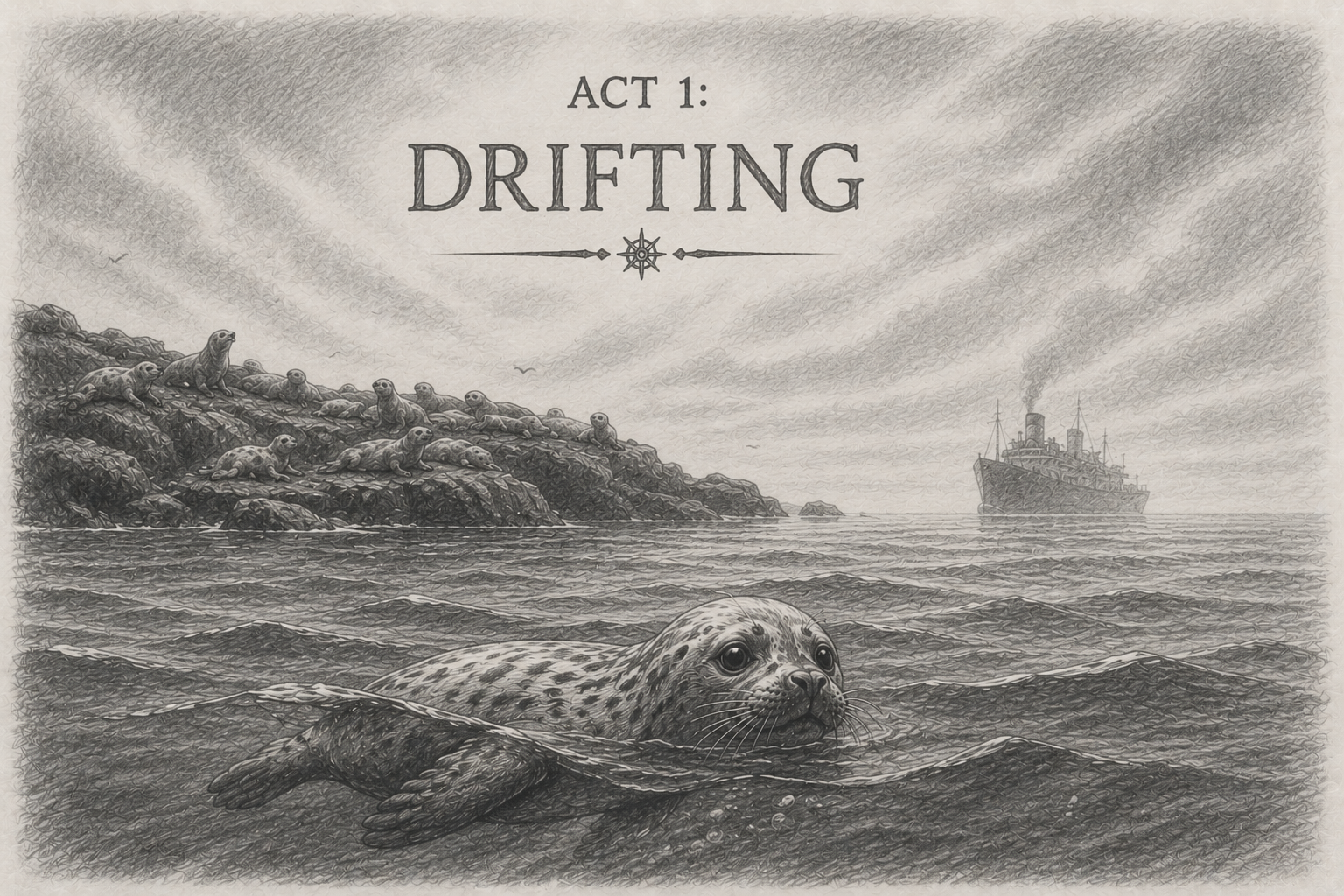
Authors note:
Hi! Adrian here. This is the longest story I’ve ever written. I just finished writing the whole thing, and I will release it in six acts. The full story is more than 20,000 words long, a short novella, and I’m really happy with it. I’ll try to make the uploads a daily occurrence, but I still have to polish the remaining 5 acts so.. we’ll see how that goes!
How did this story come to be? On October 8th 2025 I was on my way to meet someone for the first time. She was delayed, so I sat down to rest by the marina at Aker Brygge. There, I saw something in the water. Drifting towards me. At first I didn’t understand what I was looking at. And then it dawned on me. It was a dead harbor seal. It had been dead for a while. Couldn’t see if it was a male or a female. It was very eerie, never seen anything like it before. I’m not one to believe in omens, but I entertained the idea. I also wondered what the story was: how did this seal end up in the Marina, what was the cause of death, what brought it to the fjord in the first place?
The girl I met for the first time that day, she was the type of girl that slept next to seal plushies at night, and when she wrote letters to me, she drew little seals on the pages. This story does not belong to her, because that’s not the nature of stories. They don’t even belong to their authors. But it would be a lie to claim that Sealed Fate isn’t dedicated to her.
Sealed Fate is a fable about seals. It’s also a love story, but it is not a romance. What the story is actually about, that’s for you to discover, but I can reveal that it is most definitely not a story for children.
chapter 1: Origins
Before they catch their first fish, young seals are taught which waters they are to avoid.
The open ocean, where there is no rock to rest on and no colony to keep you safe.
The deep dark corners of the sea where the black and white hunters roam.
The poisonous water that burns in their eyes.
The crowded coastlines of the surface dwellers themselves, where no seal is ever out of their sight.
And then there was the great fjord to the north, where the colossal iron whales thundered through the water each dusk and dawn. The elders spoke of the fjord only in whispers. All their lives, they had been told never to swim there.
Far-Drifter had grown up among the southern skerries, but the colony there had not bred him. They had found him. One quiet morning, before he was old enough to hold a memory, he appeared with the tide. A pup too small to be away from its mother, slowly drifting towards the southern skerries from somewhere far away. The southern seals pulled him up onto the warm stone and let him stay. No colony came looking for him. No grieving calls crossed the waters in the sun-cycles that followed.
They named him for the distance he must have come, from a place none of them could name. Far-Drifter. He grew lean and strong among them, fed beside them, hunted beside them. When the cold seasons came, they let him press against their sleeping piles, but there was never room for him in the middle. He was close enough to borrow their warmth, but never buried beneath it. The colony did not mistreat him. Still, on the rocks at night, he felt the thing he could never quite put a whisker on. The small cold gap between being kept by them and being one of them.
The restlessness in his fins was older than he understood. The other seals were content with their daily lives, catching the usual fish in the calm shallows. Far-Drifter would drift to the outermost rocks and look past them, out to where the water went dark and the colony’s voices thinned to a whisper. When he looked out at the great sea, something out there called to him. As if the same tide that had once carried him to this place wanted to take him elsewhere.
During the last ice season, a young seal from the northern colonies wandered south. Quickfin, he called himself, and he carried stories the way the older seals carried scars. He spoke of storm-torn waters, iron whales the size of islands and shores where the surface dwellers lived in numbers past counting. Far-Drifter and the younglings listened eagerly to all his stories. With every tale of the outside world, the pull on him grew stronger, and more directed.
When the ocean warmed again, Quickfin turned his eyes northward. He thanked the southern colony for their hospitality, and swam away. Far-Drifter went with him, and the colony did not try to hold him back. They had always suspected that he would one day drift away from them.
Chapter 2: The Net
They followed the currents north through changing water, feeding wherever the fish gathered and sleeping when their journey allowed it. For every sun-cycle that passed, more than he could keep track of, the southern skerries were left further behind, and the light stretched longer at both ends of the day. The soft sandy shallows of the south gave way to harder, darker rock, and the fish beneath them changed their shapes and colors the farther north they went. Each sun-cycle brought something the southern skerries had never shown him.
During one of their first nights on the open sea, they came upon an iron whale standing still in the dark, pouring a pale green light down into the waters beneath it. Fish swarmed all throughout the glow, flashing their silvery scales in the green. Squid hung in the haze like drifting ghosts, mesmerized by the light in front of them. Far-Drifter had never before seen so much life gathered in one place, and he caught himself drifting towards the light. Beside him, Quickfin slowed.
“Don’t swim into the bright water,” he warned him.
Far-Drifter twitched his whiskers at the great turning mass of fish. “Why? There’s more food here than the southern colony eats in a season.”
“Fish this easy are never free.” Quickfin held back at the rim of the light. “Feed on the fish that haven’t yet reached the light, and don’t go near it.”
They fed only at the dim edges, eating the stray latecomers far from the glowing center. Far-Drifter was still grumbling about the lost opportunity when he felt the change come through the water, a deep slow vibration that descended from above.
A smaller boat slipped out from behind the iron whale, trailing something thin and nearly invisible behind it, as it circled the light beneath it.
For a moment nothing happened. Then the swarm entered a state of panic. Fish flung themselves through the green light and struck walls they could not see. They turned and dove for the bottom only to find more walls waiting below. The whole school folded in on itself in a churn of silvery panic as the invisible jaw slowly shut around it and began to rise, lifting hundreds of trapped bodies toward the dark shapes waiting on the surface above.
“What was that?” Far-Drifter breathed.
Quickfin watched it close. “A net. It’s how the surface dwellers hunt. They don’t chase fish like we do. They lure ’em, trick ’em, and collect their fill. Only the bones return to the sea.”
The net rose above the surface. Far-Drifter watched the silhouettes haul their catch into the world above. The light kept on glowing for a while, before it went dark. By then, the two seals had already moved on.
They spoke of the surface dwellers at length that night. How they hunt, how to avoid them, and how they came to be. There is a story all seals know, in every colony. The details vary from telling to telling, but the heart of it never changes.
A long time ago, the surface dwellers were seals like any other, living in the ocean like the seals of today. But they wanted more than the sea gave. The sea provides enough and no more, and for those seals, enough was never enough. So they dragged themselves up onto the land, where the tide could not reach in and wash their hoarded things back into the deep. The land took its price. It stripped them of their fur, their grace, their belonging to the water, and left them upright and cold and always wanting.
They became the surface dwellers. And their curse became ours. Their hunger never filled, and so it spilled past the shore and into the sea, and their discarded things sink down to poison the water that was once their home. The elders say it will not stop. That one day the sea will fail, and all of us with it.
And the saddest part is that they remember. Somewhere beneath all the wanting, they know the water was once theirs. That is why they cannot leave it be, why their iron whales return to roam the deep again and again. They are reaching for a home that will never take them back.
Chapter 3: The Storm
There came a stretch with no shore at all. For many sun-cycles there was no rock to rest on and no colony to keep them safe. Nothing below them but cold water going further down than the light of the sun could reach. This was the open ocean the elders had warned the pups about. They slept in turns, one of them always facing the deep below while the other one slept. Out here, with no land in sight, Far-Drifter felt very small.
Further north the sea grew violent. One evening a storm caught them and drove them towards a cluster of narrow black islets. The rocks were jagged and uneven, and the larger swells washed over any dry spots. A colony lived there, amongst the rocks, battered constantly by crashing waves. They were wary of strangers, but an old scarred bull let the two travelers haul out and rest while the rain hammered the sea around them.
His colony had not always lived on such poor rock, the old bull told them. They used to live in the gentle shores far to the east, until their colony grew too large. The bravest among them set out to find new ground.
“The hunters came at dusk,” he said. “We sensed them with our whiskers long before our eyes found them. Black and white shadows trailing us from below. To them, we were just a meal to be ripped apart and eaten.”
Far-Drifter listened silently.
“We could not fight them. We had nowhere to hide. In the open ocean, seals are at their mercy, and that night, they showed us none. All we could do was swim, but they swam faster. When they began their feast, the very sea around us turned into a crimson graveyard of our kin. Seals we had grown up with, ripped in half in front of us.”
Far-Drifter and Quickfin shuddered.
“By the time we found this place, most of us were gone.”
On the islets, the strong seals held the smooth stone near the center, where the rocks lay flat and the waves barely reached. Far-Drifter and Quickfin were given the outer edges, where the freezing spray came over them all night, and the broken rock pressed into their skin. It wasn’t comfortable, but after listening to the old bull’s tale, at least it felt safe.
When the storm broke, the old bull told them the hunters rarely entered these waters in the warm seasons. Far-Drifter and Quickfin still swam for the eastern shores as fast as their fins would carry them, and they kept to the shoreline all the way north.
Chapter 4: The Northern Colonies
By the time they reached the northern colonies, two full moon-cycles had passed since leaving the southern skerries. Far-Drifter had become an experienced wanderer. The northern colonies spread across more skerries and beaches than he could take in at once, rock after rock crowded with resting seals. He had pictured this place a hundred times on the way up.
It was not what he had pictured, or rather it was, and that was the trouble. It was only another colony. Larger, louder, but the same.
Quickfin vanished into it like a current rejoining the sea. Everywhere they swam, some seal knew his scent or his voice. He wrestled in the shallows with old companions, slipped away for long stretches among the crowded rocks, came back smelling of others. He was home. Watching him, Far-Drifter felt the old cold gap open wider than it ever had in the south. He had crossed half the world to reach a belonging that turned out to be Quickfin’s and not his own.
The days went by quiet and predictable. He watched the moon thin away to nothing and fill again, a whole moon-cycle, and in all that time the northern colony gave him no more than the southern one ever had.
At night, while the colony slept piled together on the warm stone, Far-Drifter lay at the edge and stared north, past the last of the outer skerries, toward the mouth of the great fjord. That was where the strangest stories always began. Seals swallowed whole by nets. Water that burned blue in the dark. Surface dwellers past counting. Iron whales like floating islands. They even spoke of a mighty walrus that entered the fjord some time back, looking for her mate, never to return.
Every seal who spoke of the fjord did so with fear, and Far-Drifter found that the fear, in him, came out the other side as longing. It was the only thing on the whole northern shore that still called for him.
Once, when the talk among the older seals turned to the fjord, a story came up that Quickfin knew. About a female he had grown up with, here in the northern colonies. A pup who could not make friends with the other seals, who went after boats instead. One day she left for the fjord and never came back, and now the colony spoke of her the way they spoke of the dead. They had turned her story into a lesson about keeping to the safe water, and to never stray far from the colony.
One night he found Quickfin alone on a strip of sand beyond the colony.
“You miss the journey,” he said, before Far-Drifter had said a word.
Far-Drifter let the waves answer for a while. Then “Have you ever seen the great fjord yourself?”
Quickfin lifted his head slowly. “No. Not yet.”
“Let’s go see it for ourselves, then.”
Chapter 5: Boat-Chaser
They left before first light, before the colony woke up to another day, identical to the one that came before.
The run to the mouth of the fjord was short. Where the journey north had taken two cycles of the moon, this last stretch took only a handful of sun-cycles.
The closer they got to the fjord, the stranger the water became. A low vibration hung in these currents, and never faded. The sea itself felt unsettled, never fully at rest.
Then one evening, it came out of the mist ahead of them like a cliff that had come to life. A colossal iron whale, vaster than anything Far-Drifter could have imagined. Even Quickfin had gone still. A deep thundering sound echoed in the waters as it made its way through.
Quickfin stood by his side. “That kind crosses between the surface dwellers’ kingdoms,” he murmured.
The great ship drove slowly past, hauling huge rolling waves behind it. And inside the churn of its wake, impossibly, swam a seal.
She moved through the violence as though it had been made for her, a young, scarred female cutting the white water with no fear in her at all. Quickfin went rigid.
“Boat-Chaser,” he said quietly.
“The one from the story?”
“She lived among the northern colonies once. Didn’t expect to ever see her again, figured she’d be long gone by now.”
“Why did she leave the colonies?”
“Only she knows the answer to that. What I can say is that she was never really one of us. Didn’t belong. I’m guessing she figured that out one day.”
Far-Drifter watched her vanish into the turbulence behind the ship and surface again a breath later, unhurt, already turning to go back in.
“She’s fearless!” Far-Drifter breathed, before he could stop himself.
She saw them then. Swam up out of the fading wake and looked the two of them over with attentive, unhurried eyes. They settled on Quickfin first.
“I know you.” she said. “Northern colonies. Quickfin. We were both pups last I saw you.” A flick of her whiskers, almost amused. “You always did keep to the safe water. Strange to see you this far out.”
Quickfin barely reacted. “Boat-Chaser.”
“And you’ve got a friend with you.”
She had already turned to Far-Drifter. “You’re not from up here at all.” It wasn’t a question.
And then she looked at him a while. Not the way she had looked at Quickfin, sizing up a thing she already knew. This was something else. As though she had found, in a seal she had never met, some shape she recognized. Her eyes passed over him and found no edge to stop at. The same way the fjord had given her none, years ago, the first time she saw it. Far-Drifter felt something under his ribs, in the cold gap that had never closed, and for the length of that look the gap did not feel quite so cold. Then the moment was over, and her face was careless again.
“You shouldn’t swim that close to the iron whales,” Far-Drifter said. “The blades under them can open you up.”
She didn’t answer. She turned and cut back into the dying wake one more time, and came out the other side, and this time a thin line of blood unspooled behind one of her rear flippers into the dark water.
Quickfin was already backing away. “She’s even more insane than I remember.”
Boat-Chaser glanced at the wound as if it belonged to someone else and shrugged it off with what looked like irritation. “It barely touched me.”
“You’re bleeding,” Far-Drifter said.
“You can see. Well done.” she said. “It’s mine to bleed.”
Quickfin pressed close to him, voice low. “This seal is no good. Trust me. We should go.”
Boat-Chaser had already swung north again, deeper into the fjord.
“You’re going further in?” Far-Drifter asked.
She tilted her scarred head. “All of the interesting parts are further in.”
She slid away into the mist. Quickfin watched the place where she had been.
“She’s trouble,” he said. “She’ll get herself killed one day. And anyone foolish enough to follow her.”
“She’s not going to get anyone killed.” Far-Drifter said. “She just needs someone to look out for her.”
Quickfin turned and looked at him for a long moment.
“You saw what the net does.” Quickfin said. “Lures you in, just like that, and keeps you. She’s no different.”
“You don’t know her at all, said so yourself.” Far-Drifter growled.
“Do you think there’s much of a difference,” Quickfin said, “between chasing boats and chasing after her?”
The colossal iron whale still glowed faintly through the fog. Behind them lay the colony, and the warm stone, and the easy fish, and the belonging that had Quickfin’s name on it, but not his own.
The two of them looked at each other one last time.
Quickfin turned south.
Far-Drifter swam into the great fjord.